

Newsroom
Stories Spark Change in Zambia
From 2023 to 2025, PMC-Zambia launched three pilot media projects across the Copperbelt, Eastern, and Southern Provinces. Each pilot used a different format to tackle urgent issues: family planning, HIV prevention, early pregnancy, and gender-based violence. All three produced measurable results.
“The vision behind this is to reduce early marriage and its related challenges,” said Eric Chiyombwe, PMC-Zambia Deputy Director. “We fully own the process — from conception to evaluation — and have seen the rewarding impact of our work. Feedback from pupils, teachers, and health workers confirms that our initiatives are truly life-changing.”

Insaka Ya Bumi (Community Health Dialogue Forum) — Copperbelt Province
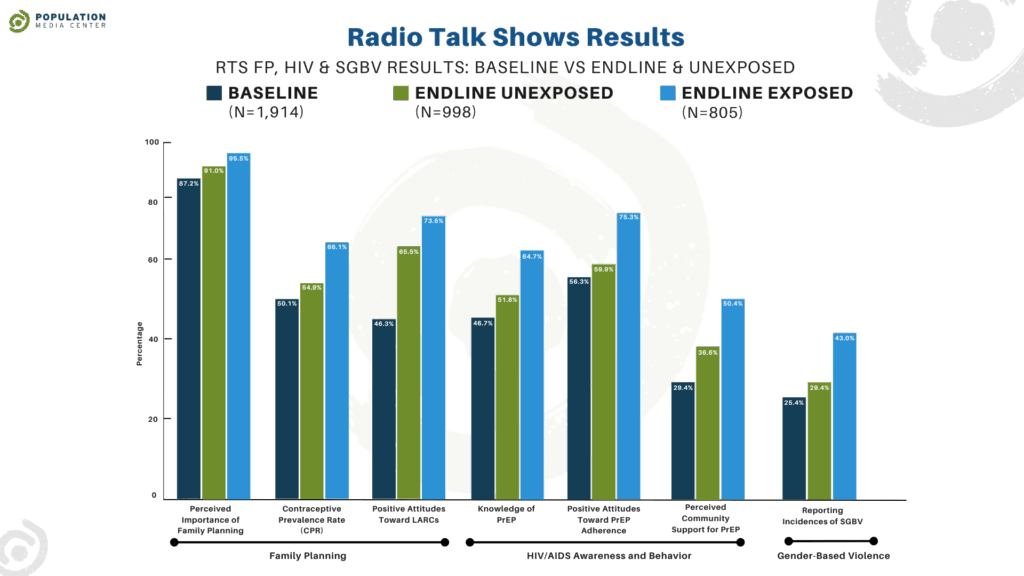
Copperbelt Province has one of the highest HIV prevalence rates in Zambia at 11.9%. In response, PMC-Zambia launched Insaka Ya Bumi — a live, one-hour call-in radio show broadcast across eight local stations. Each episode featured conversations with Ministry of Health experts and local NGOs, offering real-time answers to community questions on HIV prevention, family planning, gender-based violence, and maternal health. Each station aired 18 episodes over the course of the project.
The format layered multiple touchpoints: dramatized public service announcements — seven-minute mini radio dramas telling character-driven stories about real-life decisions like whether to get tested for HIV — aired alongside the call-in shows. Live quizzes reinforced key messages. Social media campaigns extended reach.
The results: 91.7 percent of listeners knew where to receive family planning services, up from 80.2 percent. Knowledge of PrEP — a key HIV prevention tool — rose from 46.7 percent to 57.6 percent. Two-thirds of listeners were motivated to encourage friends and family to get tested for HIV using the Social Network HIV Testing Strategy. And 67.7 percent of listeners knew where to find One-Stop Centers for gender-based violence support, compared to 49.2 percent among those not exposed.
“Radio is a powerful tool to communicate vital health messages, especially at a time when attention is shifting toward social media where most of the information cannot be easily verified by audiences,” said Charles Kalonga, PMC-Zambia Country Director. “People trust the information they hear on the radio, and they are more likely to change behaviors when they can engage directly with experts and peers.”

Kasensa Kabuumi (Fountain of Life) — Southern Province
In Southern Province, PMC-Zambia launched Kasensa Kabuumi — a four-part radio miniseries that aired weekly across five local stations, with reruns on Sundays and digital distribution on Facebook, YouTube, and Instagram. The one-hour episodes followed characters confronting hard choices around HIV prevention, family planning, and gender-based violence.
But Kasensa Kabuumi was never just about broadcast. Community dialogue meetings were recorded and aired to deepen discussion. Interactive talk shows featured experts and live listener call-ins. Community exhibitions brought the story to life — inviting audiences to engage with actors, ask questions, and access on-site services from NGOs and local partners.
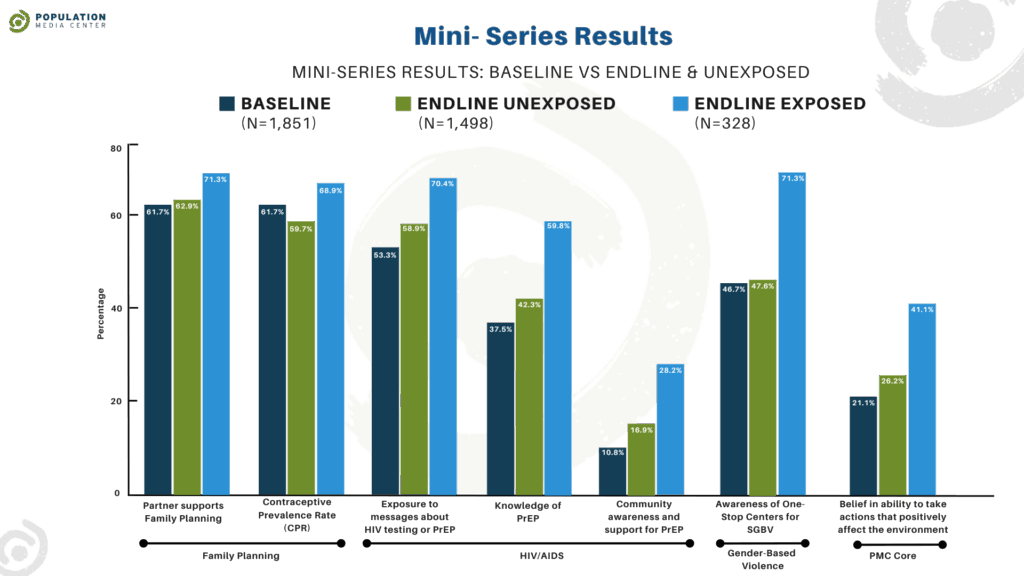
The results: roughly 4 in 5 listeners (80.2 percent) said they encouraged someone to get tested for HIV, compared to 63 percent among those not exposed. Awareness of One-Stop Centers for gender-based violence reached 71.3 percent among listeners, compared to 47.6 percent among non-listeners. And 92 percent of listeners said they would report incidents of gender-based violence if witnessed. The program also helped normalize alternative points of care for family planning: exposed individuals were significantly more likely to report drug stores (21.6 percent vs. 12.1 percent) and community-based distributors (10.9 percent vs. 5.3 percent) as sources.
“Kasensa Kabuumi has helped us realize that the way we used to do things wasn’t right,” said Titus, a resident of Choma District. “Now, more people are practicing family planning.”
“HIV cases in Chirundu have been steadily rising — currently, we have over 5,000 people on HIV treatment, most of whom are adolescents and young people,” said Felinda Zulu, HIV Coordinator for Chirundu District. “With the arrival of PMC, we’ve received valuable support in community sensitization through drama and radio programs. As a result, we’ve seen steady improvement in the retention of both adults and adolescents on PrEP.”

Dambo Lathu (Our Swamp) — Eastern Province
In Eastern Province, where teenage pregnancy touches nearly 40 percent of girls and early marriage remains widespread, PMC-Zambia tried something different: Dambo Lathu, a four-part comic book series designed not just to be read, but experienced. Over three months, PMC-Zambia brought the comics to life across nine schools in Katete and Chadiza districts. Comic panels were projected on classroom walls while facilitators narrated the stories aloud in Chichewa. Each session — 45 minutes to an hour — was followed by a live, facilitator-led discussion.
Students aged 10 to 19 listened, watched, and often recognized their own experiences. These were not distant issues — they were the realities many faced at home, among friends, or in their own lives.
“One major issue we face is teenage girls becoming pregnant by older men,” said Felix Tembo, a Community Health Worker in Kapachi District. “But through the lessons in the program, we’re learning how to respond — how to support the girl, and what steps to take. It’s giving us knowledge we didn’t have.”
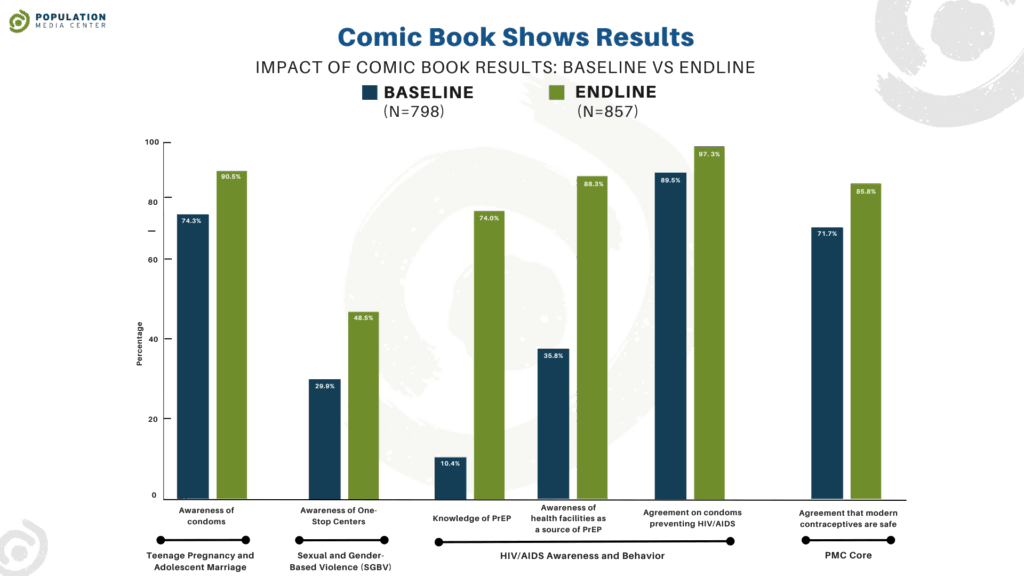
The results were striking: PrEP knowledge jumped to 74.9 percent among students who watched the comic book show — a 620 percent increase. Agreement that strict PrEP adherence is important rose from 53.8 percent to 92.4 percent. Awareness of One-Stop Centers climbed to 48.5 percent, with student awareness increasing by 22 percentage points. And awareness of condoms as a method of HIV prevention increased from 74.3 percent at baseline to 90.5 percent at endline.
“This is a good program — it’s really helped teenagers and adolescents in our area,” said Bridget Banda, Facility In-Charge at Chadiza RHC. “We’re seeing a shift in how the community thinks. People are starting to take precautions. Even school children talk about what they’ve seen in the shows.”
After every showing, community volunteers tied to local health facilities hosted dialogues using the comics as shared touchpoints for parents, elders, and young people alike. Recorded radio broadcasts of these discussions reached broader audiences across Eastern Province. Printed copies of the comic books were distributed in every participating school, giving students something tangible to revisit and share.
What These Pilots Demonstrated
Each project met people where they already were — in classrooms, on radios, in town centers — and invited them to be part of the story. By piloting different formats — from live call-in shows to radio miniseries to comic book roadshows — PMC-Zambia demonstrated that creativity and rigor go hand in hand, and that community-rooted storytelling can produce measurable shifts in knowledge, attitudes, and behaviors.
“This work will continue to help us evolve in formats and pilot,” said Natalia Cereser, PMC’s Vice President of International Programs. “This helps us test new approaches connected to the media and content that our audiences — especially the young population — are engaging with. Innovation is and will always be the way forward to test, learn, and scale.”


