

Newsroom
When Storytellers Gather: Reflections from the Impact + Profit Conference
The social impact entertainment field is at an inflection point. Hollywood is consolidating — mergers are reducing the number of studios and the diversity of voices that reach audiences. Censorship pressures are growing. Funding for global development is contracting. And the audiences that SRHR organizations most need to reach are consuming media in formats and on platforms that the field hasn’t fully adapted to.
These were the realities on the table at the Impact + Profit Conference in December 2025 at the Skirball Center in Los Angeles, hosted by the SIE Society. PMC was a proud sponsor — and our team came not just to present, but to listen, connect, and push our own thinking.
The case for bringing the room together
PMC believes that the SRHR narrative change field needs more shared spaces where entertainment creators, researchers, advocates, and funders can work through hard questions together. The Impact + Profit Conference is one of those spaces, and what made it valuable was who was in the room — and what happened when they talked to each other.
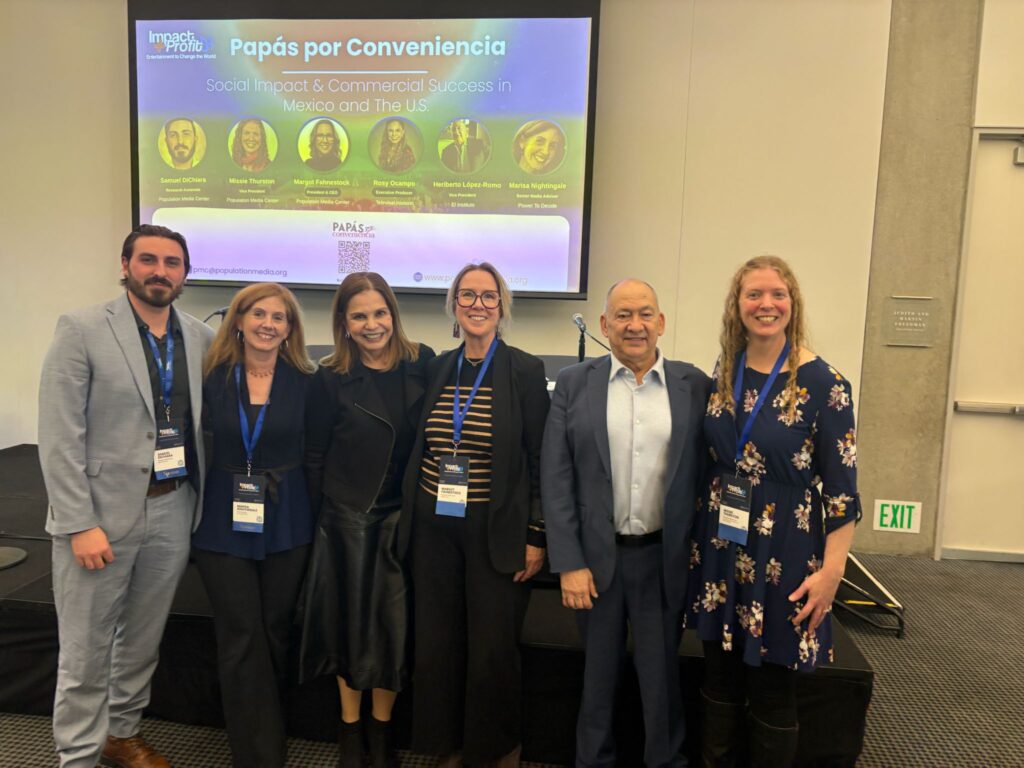
On a panel moderated by PMC’s Missie Thurston, PMC President and CEO Margot Fahnestock joined TelevisaUnivision showrunner Rosy Ocampo, Heriberto López from research partner El Instituto, Marisa Nightingale from SRHR partner Power to Decide, and PMC Research Associate Samuel DiChiara to present the impact of Papás Por Conveniencia (“Family of Convenience”). This was the model in action: a major entertainment partner, a research partner, and an SRHR advocacy partner on stage together, sharing data from a prime-time telenovela that reached more than 11.5 million viewers in Mexico and 9.5 million in the United States — and produced a 21.6 percentage point increase in adolescent viewers’ intention to use a condom.
The panel demonstrated something the field talks about but rarely sees executed: what it looks like when entertainment, research, and SRHR advocacy are integrated from the start rather than bolted on after the fact.
What we heard about the state of the field
Several themes emerged across the two days that align directly with where PMC is heading.
The entertainment landscape is in flux — and that’s an opening. “Hollywood is hurting, and mass mergers and government censorship are having a big impact in terms of the quantity and angle of content,” Thurston observed. But as Amy Henderson Riley, PMC’s Director of Research, Evaluation, and Impact, noted: “Despite changes, there is room for innovation and risk-taking.”
Measurement is a differentiator, not an afterthought. “PMC has a niche in terms of research and how we measure impact,” Henderson Riley said. DiChiara reinforced the point: “We are at the leading edge in social entertainment impact research. We embed research from the inception of any program, creating alignment between strategy and measurement from day one.” In a field where many organizations struggle to prove their impact, PMC’s ability to design evaluation into the creative process — and publish the results in peer-reviewed journals to further the field and support us all — is a genuine competitive advantage.
The audience has already moved. “The number one thing kids say they want to be when they grow up is influencers,” Thurston said. This isn’t a lament — it’s a signal. The audiences PMC needs to reach are consuming short-form content, following creators, and building their understanding of the world through platforms that the SRHR field has been slow to inhabit. That means exploring new formats, rethinking influencer partnerships as sustained collaborations rather than promotional spots, and meeting audiences where they already are.
Co-design is non-negotiable. Multiple sessions reinforced what PMC has practiced through formative research and local production teams but is always working to deepen: affected communities need to be at the table from inception, not just as interview subjects or advisory panelists, but as co-designers shaping the work.
Where this leads
Fahnestock captured it clearly: the opportunities ahead lie in “bridging the divide between entertainment and global development, linking to broader movements, defining and measuring impact, and exploring new funding partners.”
PMC’s role in that landscape is as a specific methodology and a connector. We are not a studio. We are not an advocacy organization. We are the connective tissue — the partner that brings evidence to entertainment, research to creators, and SRHR expertise to writers’ rooms. Convenings like the Impact + Profit Conference help connections form. The work that follows is where they produce results.

