Ana Akin
Program Associate


In December 2024, Population Media Center (PMC) proudly participated in the Social Impact Entertainment Society’s “Impact + Profit” Conference in Los Angeles. This prestigious event brought together industry leaders, creators, and changemakers to explore the intersection of entertainment and social impact. PMC took center stage by showcasing its groundbreaking work in entertainment-education, emphasizing how strategic storytelling can drive meaningful social and behavioral change across the globe.


Dr. Amy Henderson Riley, PMC’s Director of Research, opened one of the most anticipated panels of the conference with a discussion on “What Impact Really Means.” This session featured Dorothy Fortenberry, showrunner for Apple TV’s Extrapolations and writer for The Handmaid’s Tale; Pablo De la Fuente, producer of the Documentary The Power of One and Tobias Deml, co-founder of the SIE Society and producer of HBO’s “Gaming Wall Street.
Apple TV+’s Extrapolations is a groundbreaking series that uses compelling storytelling to explore the profound impacts of climate change on humanity. Through interconnected narratives set in the near future, the show highlights the social, environmental, and emotional consequences of a warming planet. By weaving science-based scenarios with personal stories, Extrapolations offers a unique lens into the global climate crisis, making it a standout in the realm of climate change storytelling and entertainment with impact. For viewers seeking thought-provoking content, this series is a powerful example of how media can drive awareness and inspire action on sustainability.
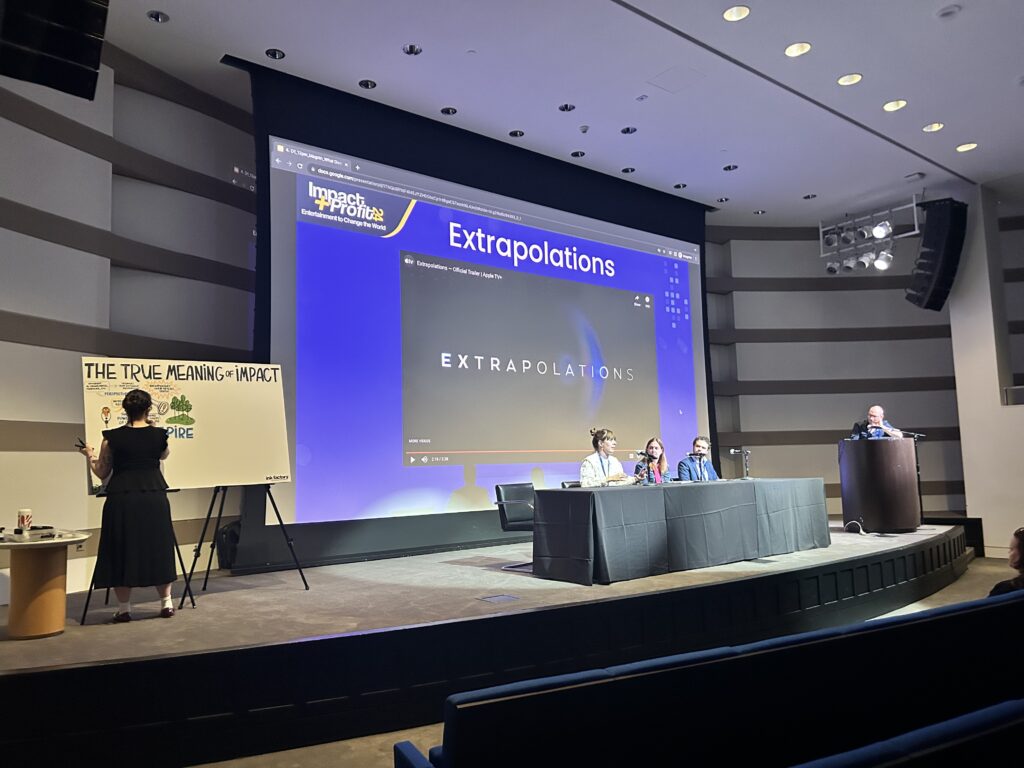
PMC brought its unique perspective to this dialogue, emphasizing the importance of aligning entertainment projects with robust theories of change, impact roadmaps, and endline evaluations.
“Impact isn’t just about storytelling; it’s about transformation,” said Dr. Riley. “Every project needs a clear pathway from narrative to measurable outcomes, and that’s where PMC excels.”
“At PMC, rigorous research and data is not optional; it’s foundational,” said Dr. Riley. “From baseline studies to impact evaluations, every project is guided by data and evidence to ensure we create meaningful and measurable change.”
PMC’s innovative video game, Breakaway, is revolutionizing the way we address social and behavioral change on a global scale. Designed to challenge harmful social norms that contribute to bullying, gender-based violence, and gender inequity, Breakaway uses immersive, narrative-driven gameplay to educate and inspire young players.
During a panel discussion, Natalia Cereser, PMC’s Vice President of International Programs, and Cody Peluso, Social Impact and Partnerships Manager discussed how Breakaway empowers students worldwide.
“By immersing players in a narrative-driven experience, we’re inspiring them to become agents of change in their communities in relevant issues like gender equity, gender violence and bullying,” said Cereser.
Educators worldwide have praised Breakaway for its ability to engage students in complex discussions about gender equity and violence prevention. Its impact is evident in the positive feedback from players who report feeling more confident and empowered to stand up against harmful behaviors in their schools and communities. As Breakaway continues to expand its reach, it exemplifies the potential of entertainment education to create lasting social change, demonstrating PMC’s commitment to using innovative tools to inspire a more equitable and sustainable future.


For over 25 years, PMC has harnessed the power of audio dramas to drive social and behavioral change in more than 50 countries worldwide. From addressing gender equity in Sub-Saharan Africa to promoting family planning in South Asia and fostering environmental sustainability in Latin America, PMC’s carefully crafted audio dramas have tackled a wide range of complex and diverse topics. These programs, grounded in rigorous research and local cultural contexts, use engaging storytelling to shift knowledge, attitudes, and behaviors. By reaching millions of listeners through community radio and other platforms, PMC’s audio dramas have empowered individuals and communities to take action.
At the conference, PMC’s project Toma Mi Mano took center stage. Natalia Cereser and Cody Peluso discussed how the audionovela, airing in the United States and Guatemala, addresses critical social issues such as unwanted teenage pregnancy and gender-based violence.
“Audio dramas allow us to reach audiences in a deeply personal way,” said Cereser. “Through relatable characters and engaging storylines, we create spaces where taboo topics can be discussed openly.”
The panel also explored how PMC tailors storytelling to resonate with diverse audiences, ensuring cultural relevance and impact.
PMC’s collaboration with Televisa on telenovelas like Vencer El Miedo and Papás Por Conveniencia has driven measurable social impact, addressing topics such as gender equity and family planning. These shows resonated with millions of viewers, fostering critical conversations and inspiring positive behavioral change.
The telenovela Vencer el Miedo, produced in collaboration with Televisa and Population Media Center, achieved significant commercial success in Mexico, captivating millions of viewers with its compelling storyline. Beyond its entertainment value, the show had a profound social impact, promoting the use of contraception and fostering conversations about family planning among young people across the country. By addressing taboo topics like unintended pregnancies and reproductive health through relatable characters and dramatic narratives, Vencer el Miedo inspired viewers to take informed actions in their own lives. The series not only boosted awareness but also contributed to increased demand for contraceptive resources, demonstrating how entertainment can effectively drive social change while achieving commercial success.
Natalia Cereser highlighted the meticulous research behind these productions.
“Our partnership with Televisa has allowed us to combine their incredible storytelling capabilities with PMC’s evidence-based approach,” she explained. “The results have been transformative, with measurable shifts in attitudes and behaviors among viewers.”
Dr. Riley expanded on this, noting how the data collected from these shows underscores the importance of embedding social change objectives into mainstream entertainment.
“When you see an increase in contraceptive use or shifts in gender norms directly linked to a telenovela, you know you’re making a real difference,” said Dr. Riley.
A robust theory of change is crucial for the success of entertainment-education projects. It outlines the step-by-step process to achieve desired outcomes, providing a roadmap for crafting impactful narratives. By identifying key challenges and expected results, theories of change ensure that characters and messaging effectively address social issues.
In entertainment-education, this framework ensures that characters, plotlines, and messaging are strategically designed to address social issues, whether it’s promoting gender equity, improving public health, or encouraging environmental sustainability. When built on data and insights from formative research, theories of change become the backbone of impactful storytelling that drives measurable progress.
In a workshop led by Dr. Riley and Mary El-Afandi, PMC demonstrated how to design an effective impact roadmap and theory of change for entertainment initiatives. This session drew a diverse audience of producers, writers, and researchers eager to integrate social impact into their projects.
“A well-crafted theory of change connects the dots between your story and your goals,” Dr. Riley explained. “It’s the blueprint that ensures your work doesn’t just entertain but also creates lasting change.”
In social and behavioral change communication (SBCC) projects, theories of change are equally vital for aligning goals with the cultural and social realities of target audiences. These frameworks help practitioners map the pathways from intervention to impact, identifying the attitudes, knowledge gaps, or societal norms that need to shift. By incorporating audience feedback and monitoring data throughout the process, SBCC projects can refine their approaches to maximize effectiveness. In both entertainment education and SBCC, theories of change are indispensable tools for creating meaningful, evidence-based content that transforms lives.


PMC’s participation in the Impact + Profit Conference reinforced the organization’s role as a leader in leveraging entertainment for social good. From video games and audio dramas to telenovelas and theories of change, PMC continues to push the boundaries of what’s possible in entertainment education.
“The conversations we’ve had here—with industry leaders, creators, and fellow changemakers—are incredibly energizing,” said Natalia Cereser. “They remind us why we do this work and inspire us to dream even bigger.”
Dr. Riley added, “We are energized by the opportunity to work alongside some of the most talented creators and changemakers in the industry. The connections made here will undoubtedly drive our mission forward.”
As PMC prepares to lead the charge in the United States and globally, the organization is poised to set new standards for research-driven, highly entertaining, and profoundly impactful media. By collaborating with visionaries and harnessing the power of storytelling, PMC is committed to creating a brighter, more equitable future for all. Looking ahead to 2025 and beyond, we remain steadfast in our mission to create a more equitable and sustainable world—one story at a time.

